The sphenoid bone is one of the most fascinating bones in the body. If you were looking at someone and could see their bones, the sphenoid would be behind their eyes and in front of their ears, with the outermost parts (the greater wings) accessible at the temples, and the lowermost parts (the pterygoid processes) being what your internal jaw muscles attach to behind your upper back teeth.
The word sphenoid comes from the Greek for wedge-shaped. Its shape has been likened to a moth, a bat, a butterfly, and a wasp. It definitely has wings!
Here’s a picture of it, as viewed from the front.

It’s a central cranial bone that does many important things:
- it connects to your internal jaw muscles
- muscles involved in swallowing are attached to it
- it helps form the orbits of your eyes
- your optic nerves meet, cross, and pass through it
- your pituitary (master gland) sits on top of it (in the “sella Turcica” — Turkish saddle!)
- it contains two air sinuses, the sphenoidal sinuses, which open into the nasal cavity through the ethmoid bone
- it has openings for major blood vessels and nerves of the head and neck
- the tentorium cerebelli, part of the membranous system surrounding the central nervous system, attaches to it
The sphenoid has been called the keystone bone of the skull. It touches 12 other cranial bones: the two parietals, two temporals, two zygomas, two palatines, and the frontal, occipital, ethmoid, and vomer.
The occiput is considered the base of the cranium. The place where the sphenoid and occiput meet is called the sphenobasilar joint (SBJ).
You can see the SBJ in the middle of the image below where the orange and yellow bones meet.
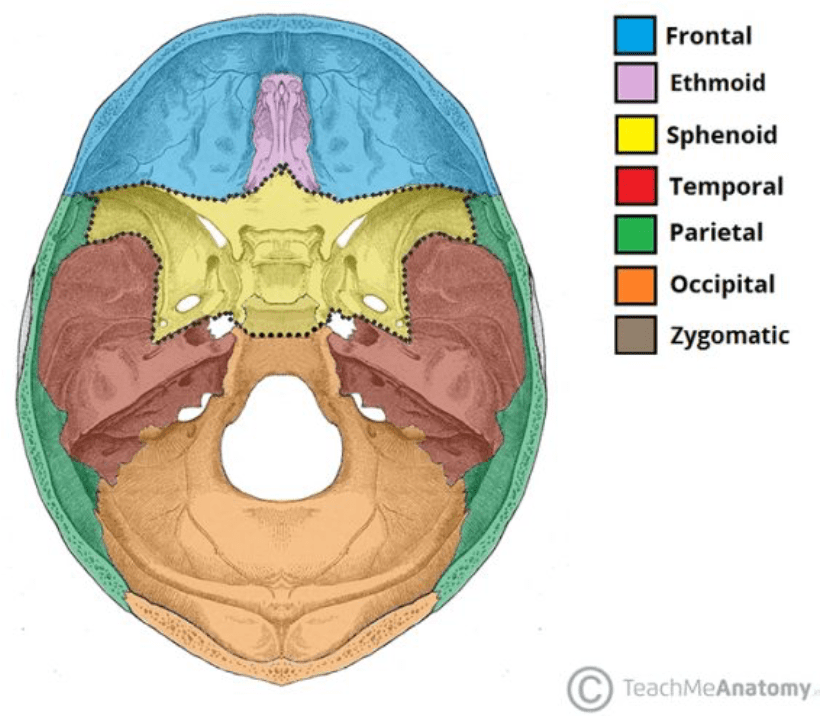
The alignment of this joint is important. William Sutherland, DO, father of cranial osteopathy, believed that the alignment of the entire skeletal system is influenced by the SBJ.
Misalignment of the SBJ obviously affects other cranial bones, which fit closely together, something like a spherical jigsaw puzzle.
If the SBJ is out of alignment, it affects the temporal bones, the upper bones of the temporomandibular joints (TMJs), colored reddish-pink in the image above.
Your internal jaw muscles attach to your sphenoid. In my TMJ Relief sessions, the clinical intraoral work relieves tension in these muscles, helping to release tension affecting the sphenoid and SBJ.
If the bones of the joints are not aligned well, it can also affect the endocrine, nervous, and cardiovascular systems.
Alignment of the SBJ is also a consideration in migraines, headaches, sinus problems, head/neck/back pain, scoliosis, eye movement, and problems with behavior, personality, learning, coordination, hormones, and emotions.
Craniosacral therapists pay a lot of attention to it and can gently help it find better alignment.
Getting this bone and joint properly aligned creates an often-subtle shift that ripples out into more ease and better health.
Does a misaligned cranial bone/bones have anything to do with a misaligned skull???? I was told my skull is misaligned to the right
Yes, your skull is like a spherical jigsaw puzzle composed of bones that ideally fit together well. A craniosacral therapist can help release strains between your cranial bones. Misalignment can happen from birth and from injuries.
Hello, can you tell me if a misaligned Splenoid bone can cause ear issues
Hi, Barbara. A misaligned sphenoid could affect the temporal bone(s), which are associated with the vestibulocochlear cranial nerve that affects hearing as well as balance. A good craniosacral therapist can align your cranial bones, and then you’ll know if that is what has caused your ear issues. Hope you find relief.
Thanks for the reply; I have very minimal hearing loss, no problems with balance. Is there imaging that could tell if the sphenoid bone is misaligned????
Not sure about imaging, but any good craniosacral therapist could tell.