Reasons people sought Craniosacral Biodynamics, Summer 2023

I compile a seasonal summary of the types of issues that my Craniosacral Biodynamics clients have sought my therapeutic help with. Creating these lists reminds me of the wide range of issues that respond to Biodynamics.

Craniosacral Biodynamics works with the body-mind-energy system’s rhythms, patterns, and physiology from the inside out in these ways:

  • deepening the parasympathetic relaxed state in which healing occurs
  • strengthening the coherence of the internal systems (nervous, digestive, etc.), improving regulation
  • facilitating the system’s ability to heal, thus increasing overall health

The list below is for sessions given between early July and September 15. Some clients had multiple issues, and in some cases, multiple clients experienced the same issue.

Maintaining wellness.

Curious about experiencing Craniosacral Biodynamics
Deepen coherence and relaxation
Deepen meditative connection
Increase sense of well-being
Prevent migraines

Recovery.

Recover from 10-year-old head injury
Recover from a fall
Recover from bump on head

Relief for specific areas of the body.

After-effects of Bell’s palsy
Back pain
Bruxism (teeth clenching/grinding)
Constipation
Pain from degenerated disc
Diarrhea
Discomfort in chest
Ear issues
Eye issues
Feeling of fullness in one ear
Headaches
Hearing loss
Hip pain
Intestinal parasites
Intracranial pressure
Jaw issues
Mast cell activation syndrome
Menstrual discomfort
Neck pain
Pain pattern on right side of body
Plantar fasciitis
Severe neck and jaw pain
Sinus congestion

Whole body issues.

Anxiety
Brain fog
Brain-based pain
Depletion
Dysregulation
Fatigue
Fibromyalgia/central sensitization
High blood pressure
High emotions
Inflammation
Insomnia
Menopause
Overwhelm
Relationship breakup

Click here to read my previous seasonal summary, for spring 2023.


Reasons people received Biodynamics, Spring 2023

Recovery

After dental work
Difficult home birth recovery
Full moon eclipse overwhelm recovery
Post-COVID recovery
Recovery from brain surgery
Recovery from hernia surgery
Releasing anesthesia after dental work

Specific Areas of the Body

Back pain
Cranial tension
Diagonal strain pattern (L hip, R shoulder)
Emergency neck pain
Headache
Intestinal upset
Jaw issues
Joint pain (shoulders, elbows, hips, knees)
Low back pain
Memory loss
Mid-back pain
Migraine prevention
Osteoporosis pain
Pain from dental work
Poor digestion
Release of force vector after injury
Respiratory allergies
Sacrum pain
Sinus congestion
Spinal pain
Tachycardia
Upper neck tension and pain

Whole Body Issues

Anxiety relief
C-PTSD relief
Long COVID relief
Depletion
Dysautonomia
“Everything”
Grief after loss of pet
Healing
Insomnia relief
Marital separation
Mast cell activation syndrome
Renewal
Seeking calm after a shock
Seeking calm before making major decision
Stress relief
Wellness boost

Click here to read my previous seasonal summary, for winter 2022-23.


Reasons people got Craniosacral Biodynamics (summer 2022)

What is Craniosacral Biodynamics? The name may not mean much if you are unfamiliar with this type of hands-on therapy.

It helps to share why people seek it, so I write these seasonal summaries of what my clients are seeking.

Craniosacral Biodynamics is different from most types of bodywork in that it works from the inside out, with internal rhythms and patterns, rather than working from the outside in, like massage therapy.

It can help with a wide variety of issues.

In every session, receivers shift into a deeply relaxed state in which the innate intelligence in their system can pause, reflect, and reorganize their tissues, fluids, and energies toward greater health.

One of the benefits of this modality is that it affects specific physical issues as well as whole body issues. The deep relaxation that clients experience empowers the body’s innate healing abilities for all kinds of issues.

Some clients come in with one issue, others with three or four. Often there’s a mix of specific physical issues and whole body issues.

Changes occur during sessions and continue afterwards. Sometimes clients notice a week or so later that an issue has disappeared.

The work is also cumulative. Often issues do not reoccur, and in subsequent sessions the work addresses deeper strain patterns and imprints of overwhelm, releasing these bound energies to return you to greater wholeness and vitality.

Specific physical issues

tension in thoracic inlet
atlanto-occipital joint tension
pain around C1 transverse process
frontal headache
tight cranial bones
mid-back strain
chest and upper back tension
neck, shoulder/s pain or tension
jaw tension or pain
sacrum unbalanced
dysfunction from old knee injury
structural asymmetry from playing a musical instrument
energy block at back of heart
vestibular cranial nerve and brain stem issues
foot pain
hip joint popping

Whole body issues

healer burnout
work-related stress
long-term stress
dysfunction from trauma
deep attachment trauma
reorganizing after releasing deep attachment trauma
fixations from Enneagram type
post-partum recovery
overwhelm from mothering young children
insomnia
anxiety
depression
PMS
overwhelm from excessive heat

Here’s the list for spring 2022.

Treating TMJ Issues: you can learn to stop clenching

In every TMJ consultation that I do, I ask about clenching. I consider it to be an important factor that contributes to jaw tension, which I treat with manual therapy.

Clenching is a habit that people do unconsciously, and most of the people who come to me for TMJ relief consultations and sessions clench and/or grind their teeth, which is called bruxism.

How does this habit start?

Common sense tells us that clenching comes from stress. If you clench, do you do it when you’re feeling relaxed and happy? Probably not!

It seems likely to be a response that represses free speech, or perhaps it started that way and then became a habitual response to stress.

People of all ages past infancy do it, even as young as three, I’ve heard anecdotally.

We’ve probably all experienced an authority figure (parent, teacher, boss, partner, etc.) who doesn’t want to hear what we have to say and who has the power to shut us down — unless we are willing to experience the consequences…which could be getting fired, isolation, abuse, punishment, abandonment, or violence.

We still think the thoughts, we still feel the emotions, but now we also have to shut up and hold our feelings/thoughts in, unexpressed. We feel threatened and want to feel safe. This creates even more stress.

We may learn that clenching our teeth keeps us safe by keeping our mouth shut…but at a cost to our own well-being.

(If you want to get better at interpersonal communication, I recommend Marshall Rosenberg’s Nonviolent Communication approach.)

We have to use our jaw muscles to clench, and overuse of these muscles creates the chronic tension in these muscles that so many with jaw issues complain about.

The pressure of clenching can cause teeth to crack and break. The dental solution is to replace broken teeth with crowns or implants. These are expensive procedures requiring a lot of time in the dental chair with your mouth wide open, which is tough on already chronically tense jaw muscles.

So what’s the alternative?

I teach what I call Relaxed Resting Mouth Position, aka RRMP. It’s very simple:

  • Close your lips and breathe through your nose.
  • Keep your teeth slightly apart.
  • Curl your tongue up so that the tip touches your upper palate behind your front teeth.

If you clench, try it now and see what you notice. How does it feel? How might it feel if it became habitual?

What if this could become your new default relaxed resting mouth position?

You can teach yourself to do this when you’re not otherwise using your mouth.

Any time you want to change a habit, first you need to become more conscious of your behavior. Then you need a healthier alternative to replace the unwanted behavior.

Repetition replaces bad habits with good habits. Enough repetition rewires your neurology.

How can I learn RRMP?

The way I teach it in my office (and now online) is to give people a few coffee stir sticks, 5-7 of them.

They can put one between their teeth, either flat or on edge, so their teeth are slightly apart, and then close their lips with their tongue tip on the roof of the mouth. Not hard at all, just to get a feel for RRMP.

I then advise them to place the coffee stir sticks in the places they habituate: for instance, on the bathroom counter, bedside table, kitchen counter, desk, dashboard, coffee table, by the remote.

Online readers, you can go to a coffee shop (buy a drink, please), take a few, and do this yourself.

Be sure to tell the neat freaks in your household to leave them where they are!

Here’s where the change happens!

The most important part of changing this habit is that whenever you spot one of these coffee stir sticks — and they will get your attention because they look like clutter — ask yourself, ”What am I doing with my mouth?”

This makes you more conscious of your clenching habit.

If you find yourself clenching, immediately switch to Relaxed Resting Mouth Position. Tell yourself how much you look forward to this becoming your new default mouth position!

Do this again the next time you notice a coffee stir stick. And the next, and the next, and the next.

No one knows just how many repetitions it will take for RRMP to become your new habit. It may take 5 times a day for 3 weeks, or more, or less.

But with repetition, increasingly you will find that your mouth is already in RRMP when you see a coffee stir stick and notice what you’re doing with your mouth.

When you’re satisfied that RRMP has become your new default mouth position, you can put the coffee stir sticks away.

Why tongue on the roof of the mouth?

This appears to come from Eastern medicine and practices. I haven’t found anything in Western medicine about it.

In Taoist practices, the two most important meridians regulating the flow of energy in the body are located on our midlines.

The conception vessel runs along your midline on the front of your body, and the governing vessel runs along your midline on the back of your body, coming over the top of your head.

These meridians meet when you place your tongue on the roof of your mouth.

This practice connects these meridians, strengthening your energy, balancing yin and yang, resulting in a state of calm alertness.

Tongue tip on the roof of the mouth is used in meditation, qi gong, tai chi, kung fu, 4-7-8 breathing, yoga, and probably more.


Reasons people sought craniosacral biodynamics (spring 2022)

Here are some reasons people have come to me for Craniosacral Biodynamics sessions in the past few months. Most of the time, people had multiple issues going on. I’ve consolidated them into general categories.

You can see that the range is wide.

  • breathing issues
  • muscle tension and/or pain (neck, throat, shoulders, upper back, lower back, chest, jaw, face, hip, glute, calf)
  • muscle twitching
  • migraine, chronic headaches, chronic migraines
  • fatigue, chronic fatigue
  • restlessness
  • nerve energy, nerve damage
  • integration after trauma, recovery from multiple traumas, physical and emotional childhood trauma
  • re-regulation after long COVID, reset after multiple challenges during pandemic
  • sadness, grief
  • emotional upheaval, severe emotional shock after break-up, feeling unsettled from work
  • managing bipolar condition
  • empty feeling at solar plexus, chaotic feeling at solar plexus, engaging personal power instead of hiding
  • insomnia
  • better heart rate variability
  • stress, anxiety, wanting to feel secure and relaxed, anxiety about upcoming presentation
  • auto-immune issues
  • holding heaviness in part of body
  • adjusting to new nightguard
  • wonky atlas, cranium feels unbalanced
  • withdrawal from psychiatric drug while waiting for new one to kick in
  • reset after various health issues
  • addressing a layer of inertia
  • three past untreated concussions

You may be curious how one bodywork modality can work with so many different issues.

The simple reason is that Craniosacral Biodynamics augments your own system’s ability to heal, no matter the cause of dysfunction. Everything in your system has a pattern, and sometimes patterns become unbalanced or strained.

Practitioners trained in Craniosacral Biodynamics can help your system move these patterns toward resolution — if they are ready to change.

We all have multiple strain patterns, and there is always something ready to transform.

How does it work? During a session we both get very quiet and still. You sink into a state of deep relaxation. Some people fall asleep. Others stay awake enough to feel shifts occurring within.

I tune into your system, and with attention and support, it pauses, gathers potency (intelligent energy), and starts reorganizing the patterns that are ready to optimize.

This work continues after you leave my office.

Here’s my list for the winter of 2021-22.

Reasons people seek Craniosacral Biodynamics (winter 2021-22)

I was curious about the reasons people have sought me out for Craniosacral Biodynamics sessions, so I looked through my intakes for sessions given since December 1, 2021.

It’s now March 29, 2022, so this sample spans nearly four months.

The variety is broad. The range includes working with very specific conditions in the tissues, chronic issues, acute issues, energetic issues, mental and emotional issues, imbalances of all sorts, recovery from medical treatment, recovery from illness, stress, and issues caused by stress.

Adjusting to Invisalign braces

Anxiety

Bell’s Palsy

Chiari malformation

Chronic pain

Depression

Emotional overload

Energetic imbalance

Familial and ancestral imprints

Fatigue, exhaustion, depletion

Feeling compressed energetically

Headaches

Long-haul COVID

Mental stress

Muscle tension

Recharge from cancer treatment

Recovery from surgery

Regular self-care

Relaxation

Strain patterns, habitual tension

Tinnitus

Trauma, PTSD, C-PTSD, childhood abuse, neglect

What people are saying about Biodynamics…

~ LD, January 2022

I’d been having problems falling asleep and staying asleep. After yesterday’s session, I slept much better! ~ LL, November 2021


Facebook post and text from long-time client LM, October 2021

After trading biodynamic sessions with AA, October 2021

From long-time client LD, October 2021

Two texts from MG, October 2021

It’s such a gift 💝 thank you ~ JH, October 2021


“You did such a great job of helping me relieve the issue, I’m so grateful for the change you made in my life. You will always be at the top of my list for referrals for tmj relief and cranial sacral.” ~ BT, July 2021


I invite you to work with me!

MaryAnn Reynolds
Austin, Texas
maryannreynolds.as.me
512-507-4184 (text or voicemail)

Treating TMJ issues: the role of the sphenoid bone

The sphenoid bone is one of the most fascinating bones in the body. If you were looking at someone and could see their bones, the sphenoid would be behind their eyes and in front of their ears, with the outermost parts (the greater wings) accessible at the temples, and the lowermost parts (the pterygoid processes) being what your internal jaw muscles attach to behind your upper back teeth.

The word sphenoid comes from the Greek for wedge-shaped. Its shape has been likened to a moth, a bat, a butterfly, and a wasp. It definitely has wings! 

Here’s a picture of it, as viewed from the front.

Screen Shot 2018-07-10 at 8.53.53 AM

It’s a central cranial bone that does many important things:

  • it connects to your internal jaw muscles
  • muscles involved in swallowing are attached to it
  • it helps form the orbits of your eyes
  • your optic nerves meet, cross, and pass through it
  • your pituitary (master gland) sits on top of it (in the “sella Turcica” — Turkish saddle!)
  • it contains two air sinuses, the sphenoidal sinuses, which open into the nasal cavity through the ethmoid bone
  • it has openings for major blood vessels and nerves of the head and neck
  • the tentorium cerebelli, part of the membranous system surrounding the central nervous system, attaches to it

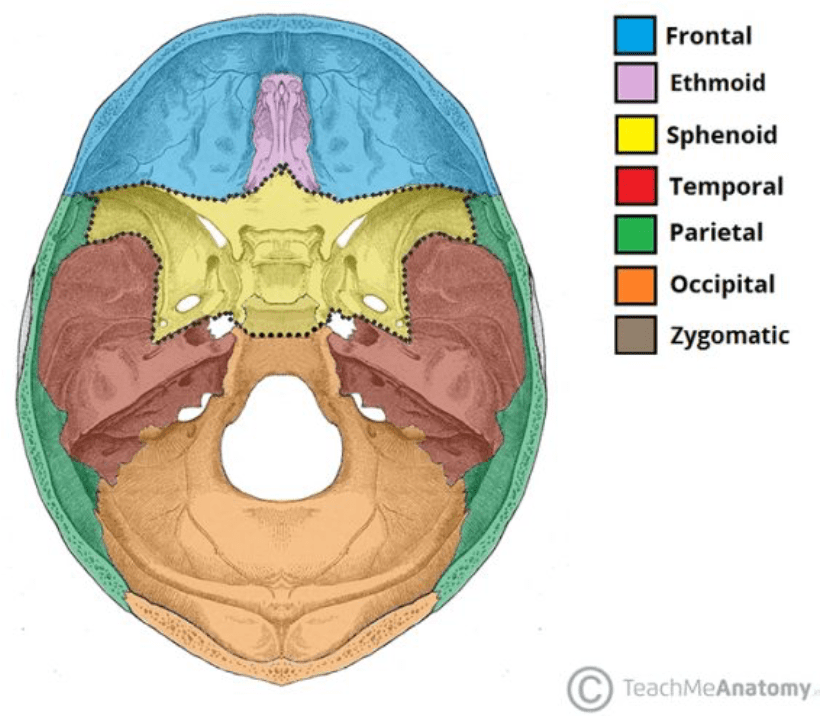
The sphenoid has been called the keystone bone of the skull. It touches 12 other cranial bones: the two parietals, two temporals, two zygomas, two palatines, and the frontal, occipital, ethmoid, and vomer.

The occiput is considered the base of the cranium. The place where the sphenoid and occiput meet is called the sphenobasilar joint (SBJ).

You can see the SBJ in the middle of the image below where the orange and yellow bones meet.

Screen Shot 2018-07-10 at 8.58.35 AM

The alignment of this joint is important. William Sutherland, DO, father of cranial osteopathy, believed that the alignment of the entire skeletal system is influenced by the SBJ.

Misalignment of the SBJ obviously affects other cranial bones, which fit closely together, something like a spherical jigsaw puzzle.

If the SBJ is out of alignment, it affects the temporal bones, the upper bones of the temporomandibular joints (TMJs), colored reddish-pink in the image above.

Your internal jaw muscles attach to your sphenoid. In my TMJ Relief sessions, the clinical intraoral work relieves tension in these muscles, helping to release tension affecting the sphenoid and SBJ.

If the bones of the joints are not aligned well, it can also affect the endocrine, nervous, and cardiovascular systems.

Alignment of the SBJ is also a consideration in migraines, headaches, sinus problems, head/neck/back pain, scoliosis, eye movement, and problems with behavior, personality, learning, coordination, hormones, and emotions.

Craniosacral therapists pay a lot of attention to it and can gently help it find better alignment.

Getting this bone and joint properly aligned creates an often-subtle shift that ripples out into more ease and better health.


Treating TMJ issues: what various professions do to help

What do various healing professions do to treat TMJ issues?

I’m going to try to answer that, to help you be better health-care consumers and know what to expect in terms of results.

By the way, I am a massage therapist who specializes in TMJ work, including intra-oral (inside the mouth) work, in which I’ve had advanced training from three teachers and experience since 2013. I admit, I am biased!

I want to say up front that most massage therapists do not work inside the mouth, which is where the jaw muscles most likely to be causing TMJ pain are located.

Most massage therapists do have the skills to release tension in the external jaw and neck muscles. Maybe that’s all you need, if your jaw pain is mild and intermittent. You will feel better after such sessions.

But if you are really suffering from long-term jaw pain and dysfunction, you definitely need more than that to get relief. You could greatly benefit from intra-oral work, which takes special training and experience to do effectively.

Do not hesitate to ask whether a therapist you are considering working with is trained in releasing tension in the internal jaw muscles.

Whole-body work can also help, when the TMJ pain is related to your posture (for instance, head forward posture) or to muscle tension due to stress.

Here’s a look at results you might expect from working with practitioners in different professions:

  • reducing stress (massage therapist, acupuncturist, yoga teacher, meditation teacher)
  • reducing tension in your external jaw muscles (massage therapist)
  • releasing trigger points in your external jaw muscles (massage therapist)
  • doing myofascial release on your external jaw muscles (massage therapist)
  • releasing neck tension (massage therapist, physical therapist, chiropractor)
  • getting your pelvis aligned and balanced (massage therapist, physical therapist, craniosacral therapist, chiropractor)
  • getting your head aligned on top of your spine (craniosacral therapist, chiropractor)
  • preventing your teeth from cracking due to grinding (dentist or over-the-counter night guard)
  • checking whether grinding in your sleep is related to airway obstruction (sleep specialist)
  • reducing tension in your internal jaw muscles (massage therapist with special training, physical therapist with special training, Rolfer as part of 10-series)
  • restoring alignment in the cranial bones (craniosacral therapist)
  • repairing or replacing a dysfunctional articular disk (oral surgeon)
  • getting whole-body therapy to help with alignment issues and release strain patterns (craniosacral therapist, Rolfer, Zero Balancer, yoga teacher, yoga therapist)

There is one major caveat here: these are generalities based on my own knowledge and experience. Each profession has its specialties. Not all physical therapists work on the jaw or pelvis — in fact, not many do.

Do not hesitate to ask questions and do your own research.

This is a brief and imperfect overview to help you get the results you want, and there are many fine points not mentioned here.


What to do if you have jaw issues? I offer a 30-minute in-person TMJ consultation to gather information and evaluate your issues. I teach clenchers an alternative to clenching as well as the above information to stop grinding.

These habits are major contributors to TMJ issues, and you can change them.

If you’re not in Austin, I can do the above as well as help you learn what to ask about when seeking TMJ relief near you. Just let me know if you need a phone or Zoom consultation.

I offer a combination TMJ Consultation plus TMJ Relief session in person in Austin, Texas. The consultation serves as an intake, so I have a better idea of what your issues are and how we’ll measure progress. Your consultation is free when combined with your first TMJ Relief session. This is a two-hour session.

To be fair, when you’ve had TMJ issues for a long time, or they are acute, you may need multiple sessions to retrain your system to retain the ease and alignment, along with doing your homework to stop clenching or grinding your teeth.

I offer a package of four TMJ Relief sessions for 10 percent off single sessions, best done a week or two apart. These sessions are 90 minutes and integrate various bodywork modalities — including work in your mouth — so that you feel great when you get off the table. They are best done over 4 to 6 weeks.

Treating TMJ issues: the jaw-pelvis connection

The jaw-pelvis connection is real! When I ask my TMD (temporomandibular disorder) clients if they also have pelvic alignment issues, a lot of them say yes.

If your pelvis is out of alignment, quite often, so is your jaw.

Here’s how that relationship works: The back of your pelvis includes the base of your spine, the triangle-shaped sacrum. Your jaw — mandible — is near the upper end of your spine, and it has a special relationship with the uppermost two vertebrae at the top of your neck, C1 and C2.

Because the opening/closing motion of the jaw is both hinging and gliding (open your mouth slowly and you can feel it hinge, then glide forward as you open wider), the axis of rotation is not in the actual jaw joints but is located between these two vertebrae, according to Guzay’s theorem (Guzay was an engineer interested in neurology).

The images below show the TMJ and the axis of rotation when with jaw closed (left) and open (right). The upper cross-hairs show the TMJ, and the lower cross-hairs show the actual axis of rotation for jaw opening and closing. 

(Image source: The Heart of Listening Volume 2 by Hugh Milne)

When your pelvis is misaligned, it affects these vertebrae, impacting neck and head posture and neurological well-being. (This is why nearly everyone I treat for TMJ issues also has neck issues, which I treat too.) 

How can the pelvis affect the jaw? There is a tough, inelastic membrane surrounding your spinal cord that connects your sacrum with your cranium. The dura mater lines the inside of your neurocranium, includes membranes between the two hemispheres and between the cerebrum and cerebellum of your brain, and forms the dural tube containing cerebrospinal fluid that surrounds the spinal cord, all the way down to your sacrum. 

The dural tube is attached to the C1, C2, and C3 vertebrae and then descends unattached all the way down the spine to the sacrum, where it attaches to bone again. The dura mater continues to the tip of the coccyx.

When the sacrum is not aligned with the other pelvic bones — in other words, when you have sacroiliac joint problems, it torques the inelastic dura mater all the way up to the upper neck vertebrae that affect the movement of the TMJs. 

This torquing of the dura mater may be seen in abnormal spinal curves, pelvic rotation or tilt, head tilt, and cranial bone misalignment, which can affect your fluids, hormones, and central nervous system.

Here’s a little exercise: put your fingertips in front of your ears and open and close your jaw slowly a few times. Notice if your left and right TMJs move differently. You may notice one side opens first and/or protrudes further out or forward than the other. 

This shows your TMJs are unbalanced. Because the mandible is one bone with two joints, even if one joint is out of balance, the other joint is affected, though you may not feel symptoms in both. 

It seems likely to me that this contributes to nine times more women than men suffering from TMJ disorders, since women have more pelvic floor issues than men. (Also more stress.)

The floor of the mouth, viewed from below.
The floor of the pelvis, viewed from above.

Other ways these two areas resonate:

  • The sacrum also crosses the midline and has two joints on either side, the sacroiliac joints. 
  • The pelvic floor and the floor of the mouth are similar in structure, as seen in the images above. Both are horizontal tissues in the more vertical body. The places where vertical and horizontal tissues meet are generally more subject to holding strain patterns.
  • Fascia in muscles and bones connects the pelvis and jaw. Restrictions in the fascia affect the alignment of bones.
  • Many people clench their jaws when stressed and may also tighten their anal sphincters. 
  • At about day 15 in embryological development, two depressions form: one develops into the mouth and the other develops into the openings at the other end of the digestive canal.