Craniosacral Biodynamic training in Austin, Texas

The Wellness Institute/Roger Gilchrist is offering training in Craniosacral Biodynamics (BCST) in Austin. This is exciting because he’s one of the most experienced teachers on the continent (30+ years, trained as a practitioner and teacher by Franklyn Sills, founder of this modality, and a master teacher).

We are fortunate to have him teaching in Austin. This level of training hasn’t been available in Austin or anywhere in Texas since 2019.

Seminar 1 was held in late September, and students were very enthusiastic about the skills they learned over the four days.

It’s not too late to join. Seminar 1 will be offered again Dec. 9-12. The remaining 9 seminars in this certification-level training will be offered every three months, in February, May, August, and November, ending in February 2028.

Teaching assistants provide support between classes.

For a description of the seminars, click here.

I did this training in Washington, DC, in 2021-23. It deepened my skills immensely. For more about this practice, click here.

Here’s what some students from Seminar 1 in September have to say about it:

“Several factors influenced my decision to choose The Wellness Institute. It’s an established institution, and Roger’s experience, along with the supporting faculty, was a significant draw. The proximity to my home was also a convenient factor.

“After completing the first seminar, I am confident that all participants will be well-prepared to become excellent practitioners. This is a thorough program that offers a personalized approach and ample opportunities for hands-on practice.” ~ Diana Tono, Norman, OK


“I feel so blessed to be learning BCST from Roger Gilchrist. He is a true master. With the help of his co-teacher, James Foulkes, you feel truly seen and heard. The teachings are clear, easy to understand, and grounded. I am excited to continue to learn and practice this work.” ~ Tempera McCarron, Sedona, AZ


I began training with the Wellness Institute after becoming deeply fascinated with BCST through the sessions I received from MaryAnn Reynolds. The work had such a powerful impact on me that I wanted to learn more about it. When I found out there would be a training in Austin, I was so excited to have that opportunity, especially since there wasn’t another training in town. I read about Roger and picked up his book, and after reading his work and receiving his very thoughtful class communications via email, I knew I wanted to learn from him and from the Wellness Institute.

After completing the first seminar, I couldn’t be happier with my decision. Roger and James did such an excellent job teaching the material and keeping everything engaging. They gave everyone individual attention and created a truly safe space to learn and experience. I reached a level of stillness that has never come so easily before. I feel confident that anyone who takes this course will become a highly skilled practitioner, if that’s the path they choose. I feel very grateful to be learning from such gifted teachers and to be part of this community. ~ Ariel Matthews, Austin, TX


I have received several treatments & taken several classes w Christian Current, one of the TA’s for the training. I have worked w several other colleagues who are also BCST certified over the yrs.

I have been asking Christian & Ryan Hallford (host of The Craniosacral Podcast, who also taught in TX) for yrs when a BCST certification training would be offered in Austin. Due to the interest of myself & many others, MaryAnn & Roger were able to organize this one. It is a special opportunity to get to study w instructors & TA’s who studied under BCST founder Franklyn Sills, who also bring their own unique knowledge, experience, skills & wisdom to this training.

The first training was quite informative, interesting, enjoyable & inspiring. A lot of information & technique was imparted for an introductory training, but the atmosphere & pace felt relaxed & comfortable. Part of the preparation involved in sensing & working w such subtle & deep mechanisms, dynamics & energy in the body requires one to slow down, to quiet oneself, tune out internal & external interference & distractions, & to be able to be attentive, present, open-minded & neutral. This in itself is therapeutic for both the practitioner & receiver, & a welcomed contrast to the daily hustle of demands, expectations, agendas, pressures, conflicts, attachments, stresses & anxieties. I love Craniosacral Therapy bc it means listening to the body & tap into its infinite inherent healing potential & wisdom. To go into this journey of discovery w this particular group of educators & students was special & powerful. There was a positive, supportive & productive dynamic & group discussion & reflection.

Roger & James did an excellent job of teaching, presenting, leading & facilitating the learning & practice. The flow w which they alternated, complemented & built upon one another’s information & ideas felt very natural & dynamic. They both bring a calm, grounded, experienced respect & enthusiasm for the work & their students, & a well-rounded, holistic, eclectic knowledge based in the science of human health & various physical, psychological & spiritual teachings. They are attentive to, & interested in, each student & help them feel seen, heard, recognized & supported. Their love for what they do helps spark the interest & passions of others for it. We are fortunate to have educators of their caliber & I am grateful & appreciative for their teachings. ~ Jesse Crandall, Austin, TX


I was directed to Christian Current for craniosacral biodynamics when I needed brain surgery in 2016. It was helpful and I felt more in control of my body and more comfortable with what was to come. 

It also helped when my infant daughter needed a frenectomy. My mother (very conventional) saw the difference in the baby’s response after the session and started getting sessions herself. 

I learned that our bodies can do more healing than our medical system gives it credit. I’m a female engineer but am planning to practice Biodynamics after training in it so I can have a 100% fulfilling career.

I was a little intimidated in the classroom on the first day because I don’t have any bodywork experience, but it was refreshing to me to instantly jump into hands-on practice twice a day. I did a lot of self-discovery in the class. I didn’t expect to know myself better in the classroom, but I did.

The benefit of this training is it’s a safe space with endless hands-on support. Plus, you’re healing yourself while you’re working on others. ~ Adrianne Marcum, Bella Vista AR


If you have any questions, please contact me. I can send you an application and answer most questions.

Roger is teaching in Prague and Sydney for the next month but is checking email. His email is wellnessinstitute@yahoo.com.

Craniosacral Biodynamic training in Austin, Texas

The Wellness Institute/Roger Gilchrist is offering training in Craniosacral Biodynamics (BCST) in Austin. This is exciting because he’s one of the most experienced teachers on the continent (30+ years, trained as a practitioner and teacher by Franklyn Sills, founder of this modality, and a master teacher).

We are fortunate to have him teaching in Austin. This level of training hasn’t been available in Austin or anywhere in Texas since 2019.

Seminar 1 was held in late September, and students were very enthusiastic about the skills they learned over the four days.

Seminar 1 will be offered again December 9-12, so it’s not too late to join. The remaining 9 seminars in this certification-level training will be offered every three months, in February, May, August, and November, ending in early 2028. Teaching assistants provide support between classes.

For a description of the seminars, click here.

I did this training in Washington, DC, in 2021-23. It deepened my skills. For more about this practice, click here.

Here’s what a couple of students have to say about it:

“Several factors influenced my decision to choose The Wellness Institute. It’s an established institution, and Roger’s experience, along with the supporting faculty, was a significant draw. The proximity to my home was also a convenient factor.

“After completing the first seminar, I am confident that all participants will be well-prepared to become excellent practitioners. This is a thorough program that offers a personalized approach and ample opportunities for hands-on practice.” ~ Diana Tono, Norman, OK


“I feel so blessed to be learning BCST from Roger Gilchrist. He is a true master. With the help of his co-teacher, James Foulkes, you feel truly seen and heard. The teachings are clear, easy to understand, and grounded. I am excited to continue to learn and practice this work.” ~ Tempera McCarron, Sedona, AZ

If you have any questions, please contact me. I can send you an application and answer most questions.

Roger is teaching in Prague and Sydney for the next month but is checking email. His email is wellnessinstitute@yahoo.com.

Craniosacral Biodynamics training in Austin, Texas

I am working with one of the most experienced teachers of Craniosacral Biodynamics in North America, Roger Gilchrist, to offer a foundation training in Austin, starting in 2025.

I completed his foundation training in Washington DC in 2023, because no training was available in Texas that I hadn’t already taken.

If you’re wondering, a foundation training consists of 10 four-day seminars spread out over 2.25 years. It meets the requirements of the Biodynamic Craniosacral Therapy Association of North America for certification — RCST® after your name indicates you completed this training and registered with BCTA/NA.

Roger is a master teacher who has taught numerous students around the U.S. and abroad. His team of teaching assistants are all RCST® certified teachers.

Where we are now:

I am gathering names and email addresses of those interested in doing such a training. So far, I have 30 names — optimal class size is 16 to 24. Not everyone who’s expressed an interest will be able to actually take the class at this time. If demand is high enough, Roger may consider adding another training later.

I am looking for a suitable location to do this training. Preferably it will be a massage school or acupuncture school — a place with classrooms and massage tables.

If you’d like to add your name to my list, please email me at mareynolds27 @ gmail . com.

If you want to know more about Roger, go to https://wellnessinstitute.net.

If you want to know more about BCTA/NA, go to https://www.craniosacraltherapy.org.

If you’d like to experience a session before deciding, you can schedule with me at https://maryannreynolds.com.

How does meditation influence Craniosacral Biodynamics?

After I started training in Craniosacral Biodynamics in 2013, I was curious about some of the terms that were used, like “the Breath of Life,” “primary respiration,” and “dynamic stillness.”

How would I know if I was experiencing these states that are considered integral in practicing Craniosacral Biodynamics? I was meditating a lot, often for 45 minutes or longer, partly because I was on a mission to discover how relaxed I could get while lucid and partly because I believed that there was likely a sensory component for these nominalized terms.

When I asked my first Biodynamics teacher about a state I’d experienced in meditation in which felt akin to sitting on the bottom of the ocean with multiple currents flowing within, through, and around me, his eyes lit up and he affirmed that I was sensing something important in the practice.

Craniosacral biodynamics and meditation overlap each other. After reading the book Craniosacral Therapy and the Energetic Body: An Overview of Craniosacral Biodynamics by Roger Gilchrist, I understood more about the spiritual dimensions that these practices have in common, one often practiced alone and the other using hands-on connection with a receiver.

I later completed a foundation training with Roger.

Here are some quotes from the book’s Chapter 18, “Spiritual Dimensions of Craniosacral Therapy”:

  • When one encounters the essence of the life force moving, it is a deeply humbling experience, as there is the immediate recognition that something moves through us that is beyond us as individuals, and beyond the conditions that we hold.
  • Note that this approach to therapy is not about a therapist working on a client; it is about a therapist coming into a direct relationship with what is here in the present moment… In a biodynamic approach there is the recognition that experience arises mutually between the client and the therapist.
  • Often as clients receive this work they come in contact with levels of their being that were previously unavailable. Many times there is a sense of depth and wholeness that is beyond anything they have encountered before.
  • Through specific training and personal guidance, we cultivate our skills of direct awareness… This way of perceiving is cultivated through personal practice… This field of perception then becomes a dynamic process of awareness that is an unwavering therapeutic ally.
  • Biodynamic craniosacral therapists, in particular, practice refining their ability to stabilize their perceptual fields at a wide level of awareness.
  • In these ways biodynamic craniosacral therapy has important overlaps with meditative practice. Many of the types of practices are similar. Even the nature of the work elicits fairly meditative states a great deal of the time… The process of this type of craniosacral therapy often takes both client and therapist into qualities of awareness and states of being that in other contexts would be described as meditative.

Biodynamic Meditation is a way to learn to experience awareness of the healing currents of life force energy within your own system.

To inquire, schedule a discovery call with me.

Treating TMJ Issues: you can learn to stop clenching

In every TMJ consultation that I do, I ask about clenching. I consider it to be an important factor that contributes to jaw tension, which I treat with manual therapy.

Clenching is a habit that people do unconsciously, and most of the people who come to me for TMJ relief consultations and sessions clench and/or grind their teeth, which is called bruxism.

How does this habit start?

Common sense tells us that clenching comes from stress. If you clench, do you do it when you’re feeling relaxed and happy? Probably not!

It seems likely to be a response that represses free speech, or perhaps it started that way and then became a habitual response to stress.

People of all ages past infancy do it, even as young as three, I’ve heard anecdotally.

We’ve probably all experienced an authority figure (parent, teacher, boss, partner, etc.) who doesn’t want to hear what we have to say and who has the power to shut us down — unless we are willing to experience the consequences…which could be getting fired, isolation, abuse, punishment, abandonment, or violence.

We still think the thoughts, we still feel the emotions, but now we also have to shut up and hold our feelings/thoughts in, unexpressed. We feel threatened and want to feel safe. This creates even more stress.

We may learn that clenching our teeth keeps us safe by keeping our mouth shut…but at a cost to our own well-being.

(If you want to get better at interpersonal communication, I recommend Marshall Rosenberg’s Nonviolent Communication approach.)

We have to use our jaw muscles to clench, and overuse of these muscles creates the chronic tension in these muscles that so many with jaw issues complain about.

The pressure of clenching can cause teeth to crack and break. The dental solution is to replace broken teeth with crowns or implants. These are expensive procedures requiring a lot of time in the dental chair with your mouth wide open, which is tough on already chronically tense jaw muscles.

So what’s the alternative?

I teach what I call Relaxed Resting Mouth Position, aka RRMP. It’s very simple:

  • Close your lips and breathe through your nose.
  • Keep your teeth slightly apart.
  • Curl your tongue up so that the tip touches your upper palate behind your front teeth.

If you clench, try it now and see what you notice. How does it feel? How might it feel if it became habitual?

What if this could become your new default relaxed resting mouth position?

You can teach yourself to do this when you’re not otherwise using your mouth.

Any time you want to change a habit, first you need to become more conscious of your behavior. Then you need a healthier alternative to replace the unwanted behavior.

Repetition replaces bad habits with good habits. Enough repetition rewires your neurology.

How can I learn RRMP?

The way I teach it in my office (and now online) is to give people a few coffee stir sticks, 5-7 of them.

They can put one between their teeth, either flat or on edge, so their teeth are slightly apart, and then close their lips with their tongue tip on the roof of the mouth. Not hard at all, just to get a feel for RRMP.

I then advise them to place the coffee stir sticks in the places they habituate: for instance, on the bathroom counter, bedside table, kitchen counter, desk, dashboard, coffee table, by the remote.

Online readers, you can go to a coffee shop (buy a drink, please), take a few, and do this yourself.

Be sure to tell the neat freaks in your household to leave them where they are!

Here’s where the change happens!

The most important part of changing this habit is that whenever you spot one of these coffee stir sticks — and they will get your attention because they look like clutter — ask yourself, ”What am I doing with my mouth?”

This makes you more conscious of your clenching habit.

If you find yourself clenching, immediately switch to Relaxed Resting Mouth Position. Tell yourself how much you look forward to this becoming your new default mouth position!

Do this again the next time you notice a coffee stir stick. And the next, and the next, and the next.

No one knows just how many repetitions it will take for RRMP to become your new habit. It may take 5 times a day for 3 weeks, or more, or less.

But with repetition, increasingly you will find that your mouth is already in RRMP when you see a coffee stir stick and notice what you’re doing with your mouth.

When you’re satisfied that RRMP has become your new default mouth position, you can put the coffee stir sticks away.

Why tongue on the roof of the mouth?

This appears to come from Eastern medicine and practices. I haven’t found anything in Western medicine about it.

In Taoist practices, the two most important meridians regulating the flow of energy in the body are located on our midlines.

The conception vessel runs along your midline on the front of your body, and the governing vessel runs along your midline on the back of your body, coming over the top of your head.

These meridians meet when you place your tongue on the roof of your mouth.

This practice connects these meridians, strengthening your energy, balancing yin and yang, resulting in a state of calm alertness.

Tongue tip on the roof of the mouth is used in meditation, qi gong, tai chi, kung fu, 4-7-8 breathing, yoga, and probably more.


Treating TMJ issues: asymmetries in the rest of the body affect the jaw joints

Jaw pain is rarely entirely in the jaw!

If you were building a tower, and one of the floors wasn’t level, it would affect the floors above it — unless you somehow compensated.

The Leaning Tower of Pisa is kind of like that, only it’s because it has settled unevenly on the ground beneath it. As they built it over the years, it would sink, stabilize, sink more…

The structure of the body is like that too — even when standing on level solid ground.

Because the jaw is near the top of the skeleton, imbalances below can affect the alignment and functionality of the temporomandibular joints (TMJs).

The primary cause of most jaw pain is asymmetrical hypertonicity. Thanks, TMJ Mastery teacher John Corry! That means that some of the muscles that affect the jaw are tighter than others.

I ask about structural anomalies in my TMJ consultations. I’m interested in whether one foot is flatter than the other, whether there’s a leg length discrepancy or a pelvic tilt or curvature of the spine.

I’ve been known to slide my hands under a client’s arches with them standing to see if their arches are symmetrical.

When a client is lying on my massage table, I can check for a leg length discrepancy.

I can also tune into their cranial rhythm and notice whether there’s asymmetry in the flexion and extension motions at the feet, which indicates asymmetry in the pelvis.

I also feel the space beneath the ears between the bones to see whether the skull is sitting symmetrically atop the spine.

When the skull and spine are out of alignment, it can contribute to multiple dysfunctions, with TMJ issues being one of them. (Ask me — I experienced intermittent right jaw clicking and my face drifting slightly to the left in meditation until a chiropractor realigned my AO joint, which also resolved issues that were all on my left side.)

1 shows the line between the mastoid processes. 2 shows the C1 vertebrae. From the sides, feel the convex bony area beneath your ears and come down up to 1/2″ to feel the ends of the C1 vertebrae. Notice if the space is symmetrical.


For more on this, including exercises you can do starting at 5:25, watch this video.

The last part of my evaluation for symmetry is to place the pads of my fingers (or have the client place their fingerpads) over the TMJs right in front of the ears and ask them to open and close repeatedly.

Often one side moves first.

Often one side feels closer to the ear than the other.

Sometimes one side sticks out more than the other.

One side may move with more ease than the other.

Try it on yourself. What do you notice?

None of this is super precise. I’m just getting a basic read on asymmetries in the client’s structure that may affect their TMJs.

Have you noticed that you have a dominant side? A side that feels stronger than the other? Most of your issues occurring on one side only?

Have you had a foot, ankle, leg, or hip injury? Can you still tell a difference between the injured side and the uninjured one? Can you balance as easily on your left foot as your right, or is one side weaker?

How’s your posture? How about your sleep posture?

Also, do you primarily chew on one side of your mouth?

Becoming more symmetrical can be a good long-term self-care project that can pay off with more ease of movement, less discomfort, better balance, injury prevention.

Symmetry is an ideal, like perfection. Most of us are doing the best we can. There’s always going to be some asymmetry in the body (our abdominal organs are asymmetrical), but we can definitely address our most dysfunctional areas.

The functional movement screen is a set of 7 movements you do with a trainer, who scores you and can prescribe workouts that strengthen your weaknesses.

FMS was developed to identify athletes who were prone to injury before they got injured. It can work for ordinary people too.

Here’s a link to view the screening movements. You can find a trainer near you online.

Practices of non-linear movement can help if done regularly over a long period. These movements work both sides of the body and increase neuroplasticity in the brain. They increase flexibility and balance and fluidity. And they are fun! Examples:

  • yoga, especially alignment-oriented types like Iyengar and Anusara
  • qi gong
  • tai chi
  • Gyrokinesis
  • martial arts
  • dance

The type of bodywork that directly addresses asymmetries is called structural bodywork. There are two main schools of training: Rolfing Structural Integration and Anatomy Trains Structural Integration. Neuromuscular therapy also assesses posture and gait pattern and can address imbalances.


Treating TMJ issues: restless legs and sleep bruxism

A new clue about bruxism.

A neurology practice noted that of its patients who had restless legs syndrome (RLS), 60% also had bruxism (grinding teeth during sleep). Eighty-three percent had RLS and migraines, and 52% had RLS, migraines, and bruxism.

Do you relate?

The lead neurologist for this study speculated there is a gene that links these conditions.

It gets more interesting. Both restless legs syndrome and bruxism are involuntary movements occurring during sleep. Is bruxism “restless jaw syndrome?”

I’m always happy to see new research about TMJ-related issues, especially because there are so many factors that play a role in jaw dysfunction and pain.

This may be something to show your doctor, or you may be interested in taking a supplement or adding foods to your diet that help your body produce more dopamine (more info below).

More about bruxism.

Bruxism includes clenching and grinding the teeth. Some distinguish these as “waking bruxism” and “sleep bruxism”.

They may have different causes.

Sleep bruxism, in contrast to daytime clenching, is harder to treat because it occurs when you’re unaware of your behavior and unable to change it.

Waking bruxism is a habit that can change with awareness and practice. I’ve helped many clenchers learn how to relax their mouth position.

Some things I’ve noted about bruxism in my manual therapy practice:

  • Many people don’t know they grind during sleep until a dentist tells them they have damaged teeth.
  • Sometimes the noise of grinding during sleep is loud enough to wake up family members or housemates, and that’s how people learn they have sleep bruxism.
  • People who grind at night often wake up with jaw, face, or neck pain, earaches, and/or headaches.
  • Bruxism often results in the need for expensive dental work: mouthguards or splints to prevent further damage, crowns to fortify cracked or broken teeth, and sometimes implants.
  • Over time, bruxism can seriously damage the temporomandibular joints to the point of requiring surgery. It’s so much better to address jaw issues before it gets that bad.

Dentists and jaw issues.

Many people expect dentists to be experts on jaw issues, yet their domain is treating the teeth and gums.

Learning about the TMJ has not been a required course in dental school until 2021-22.

General practice dentists can prevent further tooth damage with appliances like mouthguards and splints. They can repair existing tooth damage or replace teeth with implants.

Some dentists may try to adjust the positioning of the TMJs, and a few more recently-trained dentists also address airway issues (like sleep apnea, which may accompany sleep bruxism) in their work.

Dentists do not address stress or tension in the jaw muscles, which contribute so much to jaw pain. Any overworked muscle will tighten, be painful, and perhaps spasm. The jaw muscles are no different. Sometimes they get taut bands within the muscle tissue that limit range of motion.

Working with muscles is the domain of massage therapists.

I receive referrals for TMJ Relief consultations and sessions from some of the best dentists and hygienists in Austin, as well as former clients.

Solutions to try.

If you grind your teeth during sleep, it is possible to stop by using hypnotherapy or EFT (tapping).

I often recommend a recorded hypnotherapy session for bruxism that’s available on YouTube to listen to before sleep.

I don’t know if it works for everyone, but it’s soothing — I always fall asleep before it ends.

Less stress is always desirable.

I’ve also heard from someone who did this that starting a regular meditation practice can reduce or stop bruxism completely over time. There are many types of meditation. If you want to try this, choose a type of meditation that is relaxing and includes body awareness. Mindfulness-Based Stress Reduction is taught online.

As mentioned above, dopamine agonists are prescribed for low dopamine levels.

Dopamine is released when your brain is expecting a reward — when you anticipate a pleasurable activity such as eating a delicious meal, spending time with someone you love, or receiving a big check.

It’s sometimes called “the happy hormone” because it affects your enthusiasm, motivation, and focus.

If you suffer from bruxism, before going the pharmaceutical route with dopamine agonist drugs, you may want to consider nutrition — consuming foods or taking supplements that raise your dopamine levels.

In particular the amino acid tyrosine increases dopamine.

I found a few links that may be helpful:


Treating TMJ issues: portrait of a typical patient

Based on patients I’ve seen for jaw pain since 2013, I created this portrait of a typical patient. And of course, I’ve seen other patients who don’t fit these criteria.

She’s female. It’s been said that women are nine times more likely to suffer from jaw pain.

She first experienced jaw pain in her teen years.

She’s suffered for at least a decade, sometimes two decades or longer.

She clenches and/or grinds her teeth.

A dentist has prescribed an appliance to prevent damage to her teeth. The chances are 50/50 that she uses it as prescribed.

I wish I knew more about this.

Her pain level fluctuates, increasing with stress, and she usually hasn’t gone more than 6 months free from jaw pain since onset.

Her neck and shoulders are tight. Sometimes she has headaches, migraines, or ear pain.

She may also have pelvic alignment issues.

She has sought help from physical therapists, chiropractors, acupuncturists, and/or massage therapists.

She’d like to find lasting relief from her jaw and related issues.

Can you relate? How do you fit this profile, and how are you different?


Treating TMJ issues: the role of the sphenoid bone

The sphenoid bone is one of the most fascinating bones in the body. If you were looking at someone and could see their bones, the sphenoid would be behind their eyes and in front of their ears, with the outermost parts (the greater wings) accessible at the temples, and the lowermost parts (the pterygoid processes) being what your internal jaw muscles attach to behind your upper back teeth.

The word sphenoid comes from the Greek for wedge-shaped. Its shape has been likened to a moth, a bat, a butterfly, and a wasp. It definitely has wings! 

Here’s a picture of it, as viewed from the front.

Screen Shot 2018-07-10 at 8.53.53 AM

It’s a central cranial bone that does many important things:

  • it connects to your internal jaw muscles
  • muscles involved in swallowing are attached to it
  • it helps form the orbits of your eyes
  • your optic nerves meet, cross, and pass through it
  • your pituitary (master gland) sits on top of it (in the “sella Turcica” — Turkish saddle!)
  • it contains two air sinuses, the sphenoidal sinuses, which open into the nasal cavity through the ethmoid bone
  • it has openings for major blood vessels and nerves of the head and neck
  • the tentorium cerebelli, part of the membranous system surrounding the central nervous system, attaches to it

The sphenoid has been called the keystone bone of the skull. It touches 12 other cranial bones: the two parietals, two temporals, two zygomas, two palatines, and the frontal, occipital, ethmoid, and vomer.

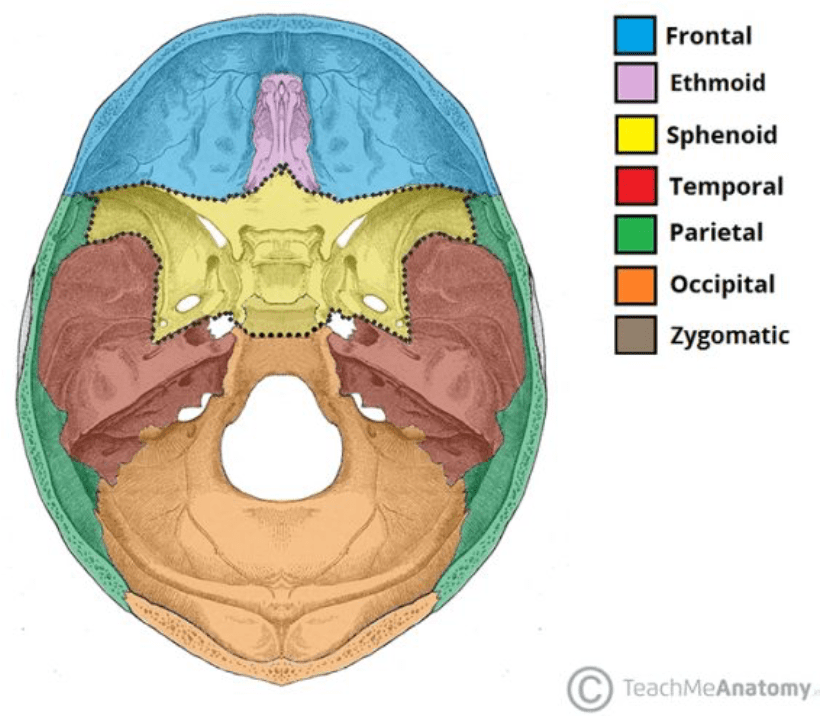
The occiput is considered the base of the cranium. The place where the sphenoid and occiput meet is called the sphenobasilar joint (SBJ).

You can see the SBJ in the middle of the image below where the orange and yellow bones meet.

Screen Shot 2018-07-10 at 8.58.35 AM

The alignment of this joint is important. William Sutherland, DO, father of cranial osteopathy, believed that the alignment of the entire skeletal system is influenced by the SBJ.

Misalignment of the SBJ obviously affects other cranial bones, which fit closely together, something like a spherical jigsaw puzzle.

If the SBJ is out of alignment, it affects the temporal bones, the upper bones of the temporomandibular joints (TMJs), colored reddish-pink in the image above.

Your internal jaw muscles attach to your sphenoid. In my TMJ Relief sessions, the clinical intraoral work relieves tension in these muscles, helping to release tension affecting the sphenoid and SBJ.

If the bones of the joints are not aligned well, it can also affect the endocrine, nervous, and cardiovascular systems.

Alignment of the SBJ is also a consideration in migraines, headaches, sinus problems, head/neck/back pain, scoliosis, eye movement, and problems with behavior, personality, learning, coordination, hormones, and emotions.

Craniosacral therapists pay a lot of attention to it and can gently help it find better alignment.

Getting this bone and joint properly aligned creates an often-subtle shift that ripples out into more ease and better health.