Treating TMJ issues: asymmetries in the rest of the body affect the jaw joints

Jaw pain is rarely entirely in the jaw!

If you were building a tower, and one of the floors wasn’t level, it would affect the floors above it — unless you somehow compensated.

The Leaning Tower of Pisa is kind of like that, only it’s because it has settled unevenly on the ground beneath it. As they built it over the years, it would sink, stabilize, sink more…

The structure of the body is like that too — even when standing on level solid ground.

Because the jaw is near the top of the skeleton, imbalances below can affect the alignment and functionality of the temporomandibular joints (TMJs).

The primary cause of most jaw pain is asymmetrical hypertonicity. Thanks, TMJ Mastery teacher John Corry! That means that some of the muscles that affect the jaw are tighter than others.

I ask about structural anomalies in my TMJ consultations. I’m interested in whether one foot is flatter than the other, whether there’s a leg length discrepancy or a pelvic tilt or curvature of the spine.

I’ve been known to slide my hands under a client’s arches with them standing to see if their arches are symmetrical.

When a client is lying on my massage table, I can check for a leg length discrepancy.

I can also tune into their cranial rhythm and notice whether there’s asymmetry in the flexion and extension motions at the feet, which indicates asymmetry in the pelvis.

I also feel the space beneath the ears between the bones to see whether the skull is sitting symmetrically atop the spine.

When the skull and spine are out of alignment, it can contribute to multiple dysfunctions, with TMJ issues being one of them. (Ask me — I experienced intermittent right jaw clicking and my face drifting slightly to the left in meditation until a chiropractor realigned my AO joint, which also resolved issues that were all on my left side.)

1 shows the line between the mastoid processes. 2 shows the C1 vertebrae. From the sides, feel the convex bony area beneath your ears and come down up to 1/2″ to feel the ends of the C1 vertebrae. Notice if the space is symmetrical.


For more on this, including exercises you can do starting at 5:25, watch this video.

The last part of my evaluation for symmetry is to place the pads of my fingers (or have the client place their fingerpads) over the TMJs right in front of the ears and ask them to open and close repeatedly.

Often one side moves first.

Often one side feels closer to the ear than the other.

Sometimes one side sticks out more than the other.

One side may move with more ease than the other.

Try it on yourself. What do you notice?

None of this is super precise. I’m just getting a basic read on asymmetries in the client’s structure that may affect their TMJs.

Have you noticed that you have a dominant side? A side that feels stronger than the other? Most of your issues occurring on one side only?

Have you had a foot, ankle, leg, or hip injury? Can you still tell a difference between the injured side and the uninjured one? Can you balance as easily on your left foot as your right, or is one side weaker?

How’s your posture? How about your sleep posture?

Also, do you primarily chew on one side of your mouth?

Becoming more symmetrical can be a good long-term self-care project that can pay off with more ease of movement, less discomfort, better balance, injury prevention.

Symmetry is an ideal, like perfection. Most of us are doing the best we can. There’s always going to be some asymmetry in the body (our abdominal organs are asymmetrical), but we can definitely address our most dysfunctional areas.

The functional movement screen is a set of 7 movements you do with a trainer, who scores you and can prescribe workouts that strengthen your weaknesses.

FMS was developed to identify athletes who were prone to injury before they got injured. It can work for ordinary people too.

Here’s a link to view the screening movements. You can find a trainer near you online.

Practices of non-linear movement can help if done regularly over a long period. These movements work both sides of the body and increase neuroplasticity in the brain. They increase flexibility and balance and fluidity. And they are fun! Examples:

  • yoga, especially alignment-oriented types like Iyengar and Anusara
  • qi gong
  • tai chi
  • Gyrokinesis
  • martial arts
  • dance

The type of bodywork that directly addresses asymmetries is called structural bodywork. There are two main schools of training: Rolfing Structural Integration and Anatomy Trains Structural Integration. Neuromuscular therapy also assesses posture and gait pattern and can address imbalances.


Treating TMJ issues: restless legs and sleep bruxism

A new clue about bruxism.

A neurology practice noted that of its patients who had restless legs syndrome (RLS), 60% also had bruxism (grinding teeth during sleep). Eighty-three percent had RLS and migraines, and 52% had RLS, migraines, and bruxism.

Do you relate?

The lead neurologist for this study speculated there is a gene that links these conditions.

It gets more interesting. Both restless legs syndrome and bruxism are involuntary movements occurring during sleep. Is bruxism “restless jaw syndrome?”

I’m always happy to see new research about TMJ-related issues, especially because there are so many factors that play a role in jaw dysfunction and pain.

This may be something to show your doctor, or you may be interested in taking a supplement or adding foods to your diet that help your body produce more dopamine (more info below).

More about bruxism.

Bruxism includes clenching and grinding the teeth. Some distinguish these as “waking bruxism” and “sleep bruxism”.

They may have different causes.

Sleep bruxism, in contrast to daytime clenching, is harder to treat because it occurs when you’re unaware of your behavior and unable to change it.

Waking bruxism is a habit that can change with awareness and practice. I’ve helped many clenchers learn how to relax their mouth position.

Some things I’ve noted about bruxism in my manual therapy practice:

  • Many people don’t know they grind during sleep until a dentist tells them they have damaged teeth.
  • Sometimes the noise of grinding during sleep is loud enough to wake up family members or housemates, and that’s how people learn they have sleep bruxism.
  • People who grind at night often wake up with jaw, face, or neck pain, earaches, and/or headaches.
  • Bruxism often results in the need for expensive dental work: mouthguards or splints to prevent further damage, crowns to fortify cracked or broken teeth, and sometimes implants.
  • Over time, bruxism can seriously damage the temporomandibular joints to the point of requiring surgery. It’s so much better to address jaw issues before it gets that bad.

Dentists and jaw issues.

Many people expect dentists to be experts on jaw issues, yet their domain is treating the teeth and gums.

Learning about the TMJ has not been a required course in dental school until 2021-22.

General practice dentists can prevent further tooth damage with appliances like mouthguards and splints. They can repair existing tooth damage or replace teeth with implants.

Some dentists may try to adjust the positioning of the TMJs, and a few more recently-trained dentists also address airway issues (like sleep apnea, which may accompany sleep bruxism) in their work.

Dentists do not address stress or tension in the jaw muscles, which contribute so much to jaw pain. Any overworked muscle will tighten, be painful, and perhaps spasm. The jaw muscles are no different. Sometimes they get taut bands within the muscle tissue that limit range of motion.

Working with muscles is the domain of massage therapists.

I receive referrals for TMJ Relief consultations and sessions from some of the best dentists and hygienists in Austin, as well as former clients.

Solutions to try.

If you grind your teeth during sleep, it is possible to stop by using hypnotherapy or EFT (tapping).

I often recommend a recorded hypnotherapy session for bruxism that’s available on YouTube to listen to before sleep.

I don’t know if it works for everyone, but it’s soothing — I always fall asleep before it ends.

Less stress is always desirable.

I’ve also heard from someone who did this that starting a regular meditation practice can reduce or stop bruxism completely over time. There are many types of meditation. If you want to try this, choose a type of meditation that is relaxing and includes body awareness. Mindfulness-Based Stress Reduction is taught online.

As mentioned above, dopamine agonists are prescribed for low dopamine levels.

Dopamine is released when your brain is expecting a reward — when you anticipate a pleasurable activity such as eating a delicious meal, spending time with someone you love, or receiving a big check.

It’s sometimes called “the happy hormone” because it affects your enthusiasm, motivation, and focus.

If you suffer from bruxism, before going the pharmaceutical route with dopamine agonist drugs, you may want to consider nutrition — consuming foods or taking supplements that raise your dopamine levels.

In particular the amino acid tyrosine increases dopamine.

I found a few links that may be helpful:


Treating TMJ issues: portrait of a typical patient

Based on patients I’ve seen for jaw pain since 2013, I created this portrait of a typical patient. And of course, I’ve seen other patients who don’t fit these criteria.

She’s female. It’s been said that women are nine times more likely to suffer from jaw pain.

She first experienced jaw pain in her teen years.

She’s suffered for at least a decade, sometimes two decades or longer.

She clenches and/or grinds her teeth.

A dentist has prescribed an appliance to prevent damage to her teeth. The chances are 50/50 that she uses it as prescribed.

I wish I knew more about this.

Her pain level fluctuates, increasing with stress, and she usually hasn’t gone more than 6 months free from jaw pain since onset.

Her neck and shoulders are tight. Sometimes she has headaches, migraines, or ear pain.

She may also have pelvic alignment issues.

She has sought help from physical therapists, chiropractors, acupuncturists, and/or massage therapists.

She’d like to find lasting relief from her jaw and related issues.

Can you relate? How do you fit this profile, and how are you different?


Treating TMJ Issues: some medications cause jaw clenching

I’ve learned that some widely used medications can cause jaw clenching and grinding as side effects.

The best known are in a class called SSRIs, selective serotonin reuptake inhibitors, commonly prescribed for depression and/or anxiety.

I’m sure you’ve heard of Prozac (generic name fluoxetine). Here are some other SSRIs that can cause bruxism. There may be others:

  • Zoloft (sertraline)
  • Celexa (citalopram)
  • Lexapro (escitalopram)
  • Paxil and Pexeva (paroxetine and paroxetine CR)
  • Viibryd (vilazodone)
  • Luvox (fluvoxamine and fluvoxamine CR)

Do not stop taking them without a doctor’s supervision, as you may have withdrawal symptoms, possibly dangerous.

This is a known problem. This link to an abstract of a 2017 journal article for psychiatrists has more. I don’t have access without paying a lot of money, but you can share this link with your psychiatrist if this applies to you, and there may be updates on this topic.

https://pubmed.ncbi.nlm.nih.gov/28492455/

In general, if you take any of these medications and you are clenching or grinding your teeth, talk to your doctor about alternatives. From the abstract: “Alternative classes of antidepressants reviewed include serotonin-norepinephrine reuptake inhibitors, tricyclic antidepressants, atypical antidepressants, and monoamine oxidase inhibitors. Findings indicate that dopamine agonists and buspirone are currently the most effective medications to treat the side effects of SSRI-induced bruxism, but results regarding the effectiveness of specific antidepressants that avoid bruxism altogether remain inconclusive.” (My italics.)

One more bit of info: I had a new TMJ Relief patient who was taking an SSRI. I treated her and gave her the info above.

Unlike others I’ve treated, she didn’t notice a difference in how her jaws felt and moved at the end of her first session.

However, she emailed me the next day to tell me that for the first time in a while, she woke up without severe jaw pain and headache.

So even if you are taking one of these SSRIs and have jaw pain, one of my TMJ Relief sessions can help.

Treating TMJ Issues: choose a practitioner who works on your lateral pterygoids

Recently I’ve had two clients come in for TMJ relief sessions who have previously seen multiple practitioners who worked inside their mouths. Between them, they have seen chiropractors, chiropractic neurologists, Rolfers, dentists trained by the Las Vegas Institute (LVI), and/or other massage therapists.

Each of these clients told me “No one has ever touched me there” after I worked on releasing tension in their lateral pterygoid muscles.

These small muscles are hard to access, being nearly surrounded by bones and tendons (cut away in the image below so you can see the upper and lower branches of the lateral pterygoid).

They are not easily accessible on everyone, being overlaid by the coronoid process of the mandible and the temporalis tendon, but they can definitely be influenced.

In my experience of giving over a thousand TMJ Relief sessions, many TMJ issues are due to an imbalance in muscle tension among the nine muscles that are directly involved in moving the mandible and numerous others that connect to the bones of the mouth and jaw.

The lateral pterygoids are often the muscles most responsible for releasing jaw tension and relieving clicking and popping noises on opening and/or closing.

Notice that the upper head of the lateral pterygoid is attached to the articular disc that separates the temporal bone and the mandible —the two bones of the temporomandibular joints.

When this disc does not move smoothly with the mandible when the jaw opens and closes in a hinge-and-glide motion, a clicking, popping, or crunching noise often occurs.

anatomy of the jaw muscles

It’s not that the other jaw muscles don’t contribute. They do. I’ve found tension in the temporalises, trigger points and taut bands in the masseters, and taut bands in the medial pterygoids, not to mention strain patterns from lower in the body.

In sessions, I work on the lateral pterygoids after working on the medial pterygoids. They can take time to access and can be sensitive, because most new TMJ Relief clients have never been touched there.

It helps to have small pinky fingers, and even then the area is so tight that sometimes I need to ask a client to shift their jaw to one side to get my finger near the muscle and joint.

Most of my TMJ clients are not aware when they come in that there are even jaw muscles there!

When I massage a lateral pterygoid, it can be a revelation. “That’s the place!” clients exclaim when I remove my finger.

Once I get there, I don’t need to stay long to make a difference. I invite my TMJ clients to move their jaws after I work on each muscle pair. Releasing tension here helps create a sense of spaciousness and ease around the joint.

To feel it for yourself, retract your mandible backward as far as you can. In other words, pull your chin in. You should feel some muscle activation in front of your ears and even in your ears. Kd

If jaw pain and tension (and clicking or popping) are your major complaint, and you’d like a sense of ease and spaciousness in your jaws, schedule a free 15-minute Discovery Call or a TMJ Relief session on my online scheduler. (I live and work in the Austin, Texas, area.)

Treating TMJ issues: de-stress quickly with these breathing techniques

Learning how to de-stress yourself is huge. Everyone experiences stress. It’s just part of life.

Stress becomes an issue when there’s too much of it, and your system has trouble rebounding resiliently to a calm, alert state.

How is this relevant to TMJ issues? So much TMJ misery is related to chronic and acute stress. It’s one of the major contributors to TMJ issues. People clench and grind due to stress, and stress is always accompanied by muscle tension, which causes a lot of jaw issues. 

Staying stressed for too long is bad for your well-being. It affects your digestion (including absorption of nutrients and detoxification) and creates unnecessary wear and tear on your vital organs.

I’m talking about bad stress as opposed to good stress, such as the anxiety before a performance that makes you a better performer, or the adrenaline you feel when a bad driver nearly hits you that helps you react quickly and successfully avoid being hit.

In my opinion, bad stress includes most news about politics (just donate money and volunteer for candidates you like) and traumatic events (there’s always something awful happening in the world).

Also, the desire to control others’ behavior can bring about bad stress. Better to focus on accepting them as they are and work on a healthy path for yourself.

Maybe they’ll witness you and want to change themselves.

You can still care and have a constructive strategy to manage stressors.

You can do these things from a calm, alert state. Imagine that.

The beauty of using a little breathwork to get yourself out of an unhelpful state of stress (any stressor that does not require immediate action) is that breathwork bypasses your mind.

Has “you need to calm down” ever helped anyone to actually calm down, whether it’s yourself or someone else telling you this?

Breathwork is also quick. You can simply do a little breathwork when stressed, and your system starts shifting into parasympathetic mode.

A note to the chronically stressed: here’s how to tell when you’re in a parasympathetic state. Your whole body starts to feel a softness and relaxation because you have let your guard down. You notice your that breathing has changed, to becoming slower, deeper, with longer pauses. 

If this is hard, because maybe you’ve been carrying the guarding that often occurs after a trauma, try this: Imagine yourself in a completely safe environment where you don’t have to be guarded against anything. Maybe you are surrounded by softness, or floating in body-temperature water. You may have any objects (real or imaginary) that bring you comfort. 

Let go of your thoughts and just be. 

The more you practice breathwork and conscious relaxation, even when not stressed, the more it gets wired into your neurology.

The physiological sigh

The physiological sigh is breathwork technique that’s getting a lot of attention now. It’s been recognized for 80 years as a behavior people do automatically when claustrophobic and in other stressful situations.

Now you can put it to work for yourself when you need to de-stress yourself.

I learned about it from Dr. Andrew Huberman, a Stanford University professor who runs a neurobiology lab and has a podcast.

In brief, it’s two inhalations through the nose, and one longer exhalation through the mouth. (I think of it as the “sniff sniff ahhhhh” breath.)

Here’s a video demonstrating technique.

Dr. Huberman says sometimes people fall asleep if they do it 15 times in a row, but just three of these physiological sighs are enough to start slowing your heartbeat down in 20-30 seconds.

I nearly always yawn when I start doing physiological sighs.

4-7-8 breathing

Another fairly quick breathwork technique for reducing stress is the 4-7-8 breathing (the Relaxing Breath). Dr. Andrew Weil, who has been practicing and writing about holistic health and integrative medicine for 30 years, came up with it.

Dr. Weil recommends doing four of these breath cycles at least twice a day for two months to get the benefits. This wires it into your neurology.

He recommends slowing the cycle down, with the limiting factor being how long you can comfortably hold your breath.

It can also help with cravings and falling asleep.

In essense, you are retraining your nervous system to be more relaxed.

You may become less stressed from using either or both of these techniques and still benefit from receiving a TMJ Relief session to retrain your jaw muscles into relaxation. The breathwork will help your body retrain itself more quickly and prevent relapses.

If you’re ready to have that conversation with me, please connect. I’d love to hear from you.


Treating TMJ issues: releasing trigger points in your jaw muscles

You have nine jaw muscles: two pairs of large ones on the outside of your head (the masseters and temporalises), four small ones inside your mouth (two medial pterygoids and two lateral pterygoids), and one in the floor of your mouth (digastric).

Any of them can get trigger points.

What is a trigger point? It’s unhealthy muscle tissue that causes pain that can occur locally to the trigger point or at some distance — referred pain.

Healthy muscle tissue is made of bundles of fibers that run in the same direction. This tissue is pliable. It contains fluid. It stretches or contracts when you move.

Screen Shot 2018-07-12 at 8.36.04 AMA trigger point is a spot where the muscle tissue has lost its pliability. A massage therapist may feel that some tissue in a particular spot feels hard, creating a small nodule that’s hard and stiff. The tissue feels dense and often rolls under the fingers when compared to healthy muscle tissue.

Trigger points cause that band of muscle fibers within a muscle to shorten and tighten, restricting full range of movement of the entire muscle.

Trigger points feel tender when you apply pressure to them.

Where several of them occur in an area, they form “constellations.” If one of those trigger points in the constellation is the primary one and the rest are satellites, it takes trial and error to locate and treat the primary one — and until that happens, the satellites keep reoccurring.

This makes them the tricksters of the nervous system, and it’s why specialists in trigger point therapy are rare and sought after.

You can work on your own trigger points to release them. It helps if you’ve received trigger point work from an experienced massage therapist, but you can learn to do it yourself. Even then, you may prefer to have a massage therapist work on them, especially if you have a lot of them.

Even with an experienced therapist working on your trigger points, sometimes the body clearly says “no more today,” a signal to move on to another technique and schedule another session.

Screen Shot 2018-07-12 at 8.08.14 AMMy favorite reference book for working with trigger points is The Trigger Point Therapy Workbook, third edition, by Clair Davies and Amber Davies.

It is written for laypeople to release their own trigger points, but many massage therapists use it as a reference book in their offices. I got my copy spiral-bound for ease of use.

When I am working on TMJ issues, I sometimes notice that people have trigger points in their masseters, the big external jaw muscles on the sides of your face that run from your cheekbone to the bottom of your jawbone.

Here’s how to find trigger points in your own jaw: using a bit of pressure, drag your fingers slowly down the masseter muscle on both sides of your face. Do this several times, experimenting with adding pressure, and notice if there are tender spots or small dense spots that roll under your fingers. Repeat on the other masseter.

If you don’t have masseter trigger points, this usually feels pretty good.

Screen Shot 2018-07-12 at 8.41.19 AM
Left: trigger point locations in the left masseter. Right: areas of associated pain. Source: The Trigger Point Therapy Workbook. 

If you find trigger points in your masseters (and you can have other TMJ issues without them), there are several ways of treating them.

Some therapists apply a huge amount of pressure. I don’t recommend this because if you have TMJ issues, your jaw is probably already out of alignment, and applying lots of pressure could make it worse.

A better way, in my opinion, is to use less pressure. Yes, you can gently release trigger points!

I learned to do this from a local (Austin) massage therapist, Rose of Sharon, who is very experienced with trigger point release. She’s worked on me and released many trigger points, teaching me how to do this in the process.

If you have a lot of trigger points, I highly recommend seeing her. She’s amazing at discovering patterns if you have “constellations” of trigger points.

If you are interested in having her work on you, you can reach her by phone or text at 512-282-1672. Please leave a message with your name and number so she can contact you.


Treating TMJ issues: music and meditation to heal the throat chakra

Previously I shared two links to YouTube recordings of music to heal the throat chakra in this post, in case you missed it.

Today, I want to share more about this.

Keep in mind that the throat chakra includes the throat, jaw, chin, mouth, lips, cheeks, nose, and ears — basically from the clavicles to the eyes. 

Sound penetrates our bodies. We’ve probably all felt the vibration in our bodies when we’ve been near a large bell being rung or a gong being struck or loud music coming through a speaker.

Since sound travels in waves, and we are made of waves as well as particles, of course it enters our tissue, fluid, and energy fields and influences us.

The human love of rhythm and music must go way back, long before writing and probably before language. Harmonic sound is pleasing, and we are immersed in natural rhythms: our heartbeats, breath, deeper rhythms within us, circadian and celestial rhythms, life cycles. 

I believe sound can harmonize our bodies at a cellular level, creating higher coherence, which means our various systems coordinate with each other better.

Can sound cure cancer? I haven’t heard of that, but I believe it’s possible.

In my experience, sound can definitely create a sense of inner peace.

Insight Timer

I use the free smart phone app Insight Timer for meditation. It has a timer for silent meditation, chanting, and breathing among other practices, and thousands of guided meditations and music for meditation.

In the app, you can do a search on “throat” to find guided meditations and music for the throat chakra. There are many! 

I found seven musical meditations, ranging from 4 to 35 minutes in length. The one I’ve listened to most is Throat Chakra Singing Bowls, by Sonic Yogi (29 minutes).

(If you don’t want to use the app, that meditation is also available on Bandcamp here.)

Self-Healing

Healing takes place when we are relaxed, when our parasympathetic nervous systems (rest and digest) are dominant.

If music can help get us there, our bodies can work on healing.

To take your self-healing further, while you listen, visualize sky blue or turquoise light surrounding your neck and jaws.

Imagine a sense of spaciousness.

Deliberately relax the tight muscles with each exhalation.

If you are suffering from TMJ pain and discomfort, I hope you will find some relief from listening to music designed to clear and heal the throat chakra.


Treating TMJ issues: the role of the sphenoid bone

The sphenoid bone is one of the most fascinating bones in the body. If you were looking at someone and could see their bones, the sphenoid would be behind their eyes and in front of their ears, with the outermost parts (the greater wings) accessible at the temples, and the lowermost parts (the pterygoid processes) being what your internal jaw muscles attach to behind your upper back teeth.

The word sphenoid comes from the Greek for wedge-shaped. Its shape has been likened to a moth, a bat, a butterfly, and a wasp. It definitely has wings! 

Here’s a picture of it, as viewed from the front.

Screen Shot 2018-07-10 at 8.53.53 AM

It’s a central cranial bone that does many important things:

  • it connects to your internal jaw muscles
  • muscles involved in swallowing are attached to it
  • it helps form the orbits of your eyes
  • your optic nerves meet, cross, and pass through it
  • your pituitary (master gland) sits on top of it (in the “sella Turcica” — Turkish saddle!)
  • it contains two air sinuses, the sphenoidal sinuses, which open into the nasal cavity through the ethmoid bone
  • it has openings for major blood vessels and nerves of the head and neck
  • the tentorium cerebelli, part of the membranous system surrounding the central nervous system, attaches to it

The sphenoid has been called the keystone bone of the skull. It touches 12 other cranial bones: the two parietals, two temporals, two zygomas, two palatines, and the frontal, occipital, ethmoid, and vomer.

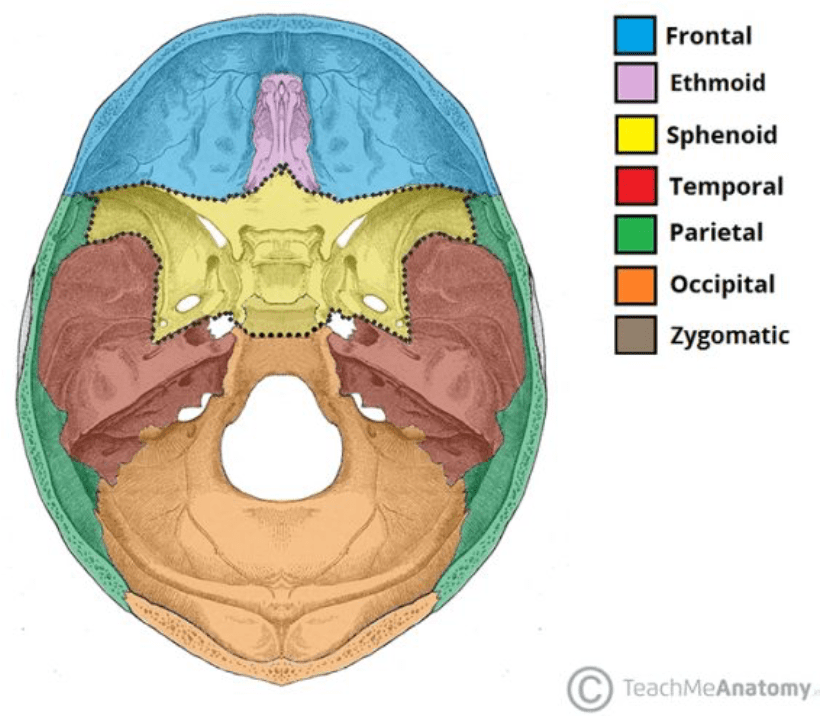
The occiput is considered the base of the cranium. The place where the sphenoid and occiput meet is called the sphenobasilar joint (SBJ).

You can see the SBJ in the middle of the image below where the orange and yellow bones meet.

Screen Shot 2018-07-10 at 8.58.35 AM

The alignment of this joint is important. William Sutherland, DO, father of cranial osteopathy, believed that the alignment of the entire skeletal system is influenced by the SBJ.

Misalignment of the SBJ obviously affects other cranial bones, which fit closely together, something like a spherical jigsaw puzzle.

If the SBJ is out of alignment, it affects the temporal bones, the upper bones of the temporomandibular joints (TMJs), colored reddish-pink in the image above.

Your internal jaw muscles attach to your sphenoid. In my TMJ Relief sessions, the clinical intraoral work relieves tension in these muscles, helping to release tension affecting the sphenoid and SBJ.

If the bones of the joints are not aligned well, it can also affect the endocrine, nervous, and cardiovascular systems.

Alignment of the SBJ is also a consideration in migraines, headaches, sinus problems, head/neck/back pain, scoliosis, eye movement, and problems with behavior, personality, learning, coordination, hormones, and emotions.

Craniosacral therapists pay a lot of attention to it and can gently help it find better alignment.

Getting this bone and joint properly aligned creates an often-subtle shift that ripples out into more ease and better health.


Treating TMJ issues: acupressure points for self-care

Recently I wrote about how acupuncture can help relieve jaw pain and the stress that often accompanies it. Today’s post is about doing acupressure on yourself for TMJ issues.

Keep in mind that if you see an acupuncturist, they will do an evaluation that may show other issues that they can address, with a focus on getting your whole system in balance.

Screen Shot 2018-07-06 at 8.53.21 AM
Image source: acupressure.com

But acupressure can help. The leading expert on using acupressure, Michael Reed Gach, Ph.D., has a page on pressure points for sinus problems, jaw, TMJ, and bruxism and includes a 4:07 video (go to 1:18 for the jaw points).

He recommends holding them for a couple of minutes 2-3 times a day for a few weeks or months for best results if your jaw pain is chronic. Sinus, Jaw, TMJ and Bruxism Acupressure is 4:08.

Heather Wibbel’s video (3:43) shows four points to apply pressure.

This site has good images of four points, two of which Heather covers (SI 19 and ST6), with two other points on the cranium (ST7 and GB12) that can help.

(Note: If you Google this topic, be aware that not all the results are credible. I found one that pictured ST36 on the leg while describing a point on the face!)